VEND makes the asset legible.
Connect machine activity, payments and operating history to a persistent financial record.
 Docs / Public
VEND makes the asset legible.
Connect machine activity, payments and operating history to a persistent financial record.
Credit partners make the decision.
External partners set policy, structure terms, approve credit and provide capital.
Inspect machine activity, compare locations and identify the operating evidence still needed for a financing review.
Explore Korea 13’s three laundries, choose an amount from $25 and review estimated interest after fees and scheduled repayments.
Review product evidence, submit a non-binding participation application and follow its status in the workspace.
Korea 13 terms describe the current Personal product. Estimated interest falls as principal is repaid; these settings do not determine institutional facility terms. A participation application is separate from an allocation or executed financing.

Usage, uptime, activity and asset-condition context.
Financial activity, revenue and reconciliation evidence.
Broader borrower and location context.
Can stressed operating cash flow support debt service?
What equipment value may be recoverable?
Who operates the asset, and what does the operating history show?
How can payment visibility support servicing and repayment discipline?
VEND supports underwriting. It does not make the underwriting decision.
Strong debt-service capacity and stable operating performance.
Adequate coverage and normal operating performance.
Coverage or operating trends require closer monitoring.
Credit-partner review may be required.
Signal thresholds and actions are calibrated with the relevant credit partner. Public documentation does not expose internal numerical working bands.
CoinUp locations
Partner-network users
Partner-machine activity
Indexed asset nodes
Current published activity index
Indexed identities
Records with transaction proof
The product separates machine-use activity amounts from kiosk top-ups, then connects operating history to normalized fields and traceable evidence. Published amounts are USD-converted activity records; bank receipts and operating costs still need reconciliation.
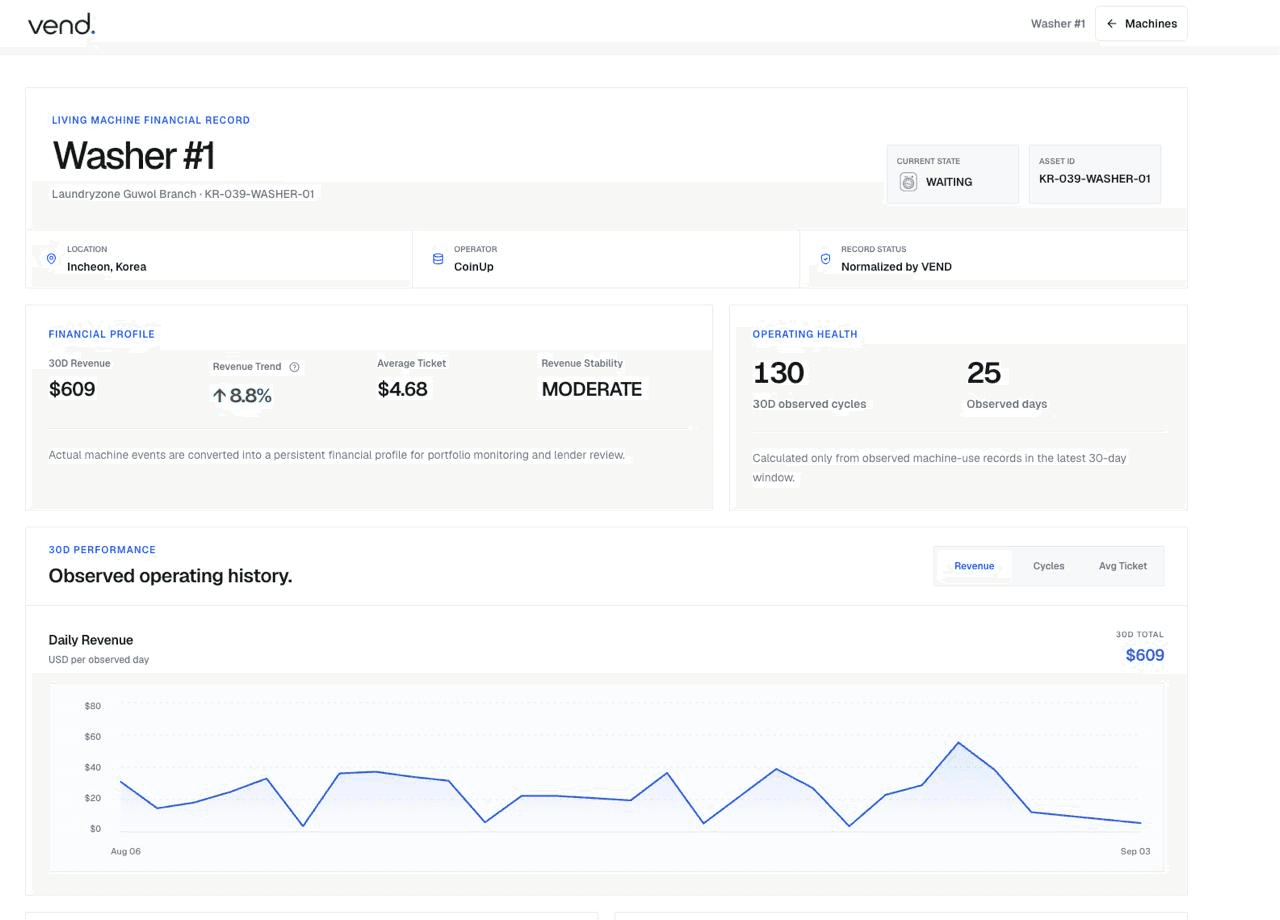
Actual observed 30-day machine-use records, with comparison logic separated from the headline revenue total.
One compact 30-day view makes the productive machine readable without turning it into a retail investment product.
Source-native operating events become a consistent VEND machine financial record.
Transaction-linked references remain available as the verification layer behind the financial profile.
Partner-network figures are not VEND assets, revenue, assets under management or funded loans. Live VEND figures are loaded from the same current scanner index used by the POC.
Observed Korea cases show meaningful modeled coverage under the current working structure.
Multiple Mongolia locations demonstrate performance beyond a single pilot asset.
Early Kazakhstan locations remain visible because not every asset should qualify on the same terms.
Store-level CAPEX, monthly cash flow, modeled debt service, DSCR bands and the detailed campus economics are available in qualified private diligence.
Machine deployment · operator network · operating context
Data · financial profiles · monitoring · servicing
Credit structuring · underwriting · credit policy
Funding subject to approval and agreed structure
Establish the credit structure, controlled collections, service payer and reporting scope, then build an actual repayment record. Execution remains subject to approval and agreed terms.
Agree the borrower request, credit structure, collection controls and VEND service scope before execution.
Use reconciled repayments and accepted reporting to support the next allocation.
Combine locations when performance history, receivable control and concentration review support the transaction.
Adapt records and servicing to each machine category, with appropriate credit, ownership and collection arrangements.
Potential origination pools include new locations, repeat operators, university infrastructure, equipment replacement and overseas rollout. Capacity follows qualification and execution—not a top-down TAM.
A retained share of the closing fee for agreed onboarding, record preparation and servicing setup. The fee pool, VEND share, scope and contractual payer are agreed for each facility.
Repayment tracking, cash reconciliation, exception follow-up and lender reporting. Revenue follows billable outstanding balances as principal is repaid, under the agreed service contract.
These fees describe the core credit-service business. Manufacturer leasing and paid data services extend the same operating foundation; each requires validated demand, an agreed service scope and its own commercial terms.
Support manufacturers and distributors with usage records, credit-file preparation, servicing and equipment remarketing. Operators pay over an agreed term or according to usage; the manufacturer or a partner-funded vehicle owns the equipment.
Restaurant and service robots are a potential next application, using store cash flow, machine usage and labour savings in the credit file. Each program needs appropriate financing partners and agreed ownership, recovery and residual-value responsibilities.
Connect operating and repayment history into financial profiles, monitoring feeds and data licences for lenders, insurers, manufacturers and asset owners. The same records can support financing and ongoing decisions about the machine.
Develop paid services around a specific customer need. Data access, derived-data use and resale rights must be agreed with CoinUp and each relevant operator, with appropriate permissions or licensed partners where required.
Leasing and Data are development directions. Expansion follows customer demand, workable service economics and partner readiness. Each new machine category needs its own credit criteria and operating evidence.
Operator activity, location comparisons, freshness checks, machine records and CSV exports.
Personal product review and repayment schedules; Institutional participation applications and status.
Agree the borrower request, credit responsibilities, cash controls and VEND service contract. Reconcile operating records with settlement and bank evidence.
Use actual repayments and paid servicing to support follow-on capital and make the next integration easier to deliver.
Extend the same records and servicing into manufacturer programs, starting with a partner-backed machine category and a defined customer need.
Develop monitoring feeds, financial profiles and data licences around validated customer needs and agreed data-use rights.
VEND becomes the persistent data, monitoring and servicing layer connecting machine operators to credit partners and capital.